
Why Education Ads in Malaysia Get Attention But Not Enrolments
Short answer: Most Malaysian college and university ads are written for people who have already decided to enrol. But the majority of people clicking are still discovering. The fix is not a better headline. It is building the ad from what your existing students actually said about why they chose you, then matching the message to the stage the person is really at.
I pulled up SEGi University & Colleges' live ads in the Meta Ad Library, ran their public Google reviews through our customer intelligence process, and rebuilt the angles. Everything below is the actual working, so you can run it on your own institution today.
Watch the full audit: I recorded the whole walkthrough on screen, the ad library comparison, the review extraction, and the rewritten angles side by side. Watch it on YouTube.
Why I picked SEGi
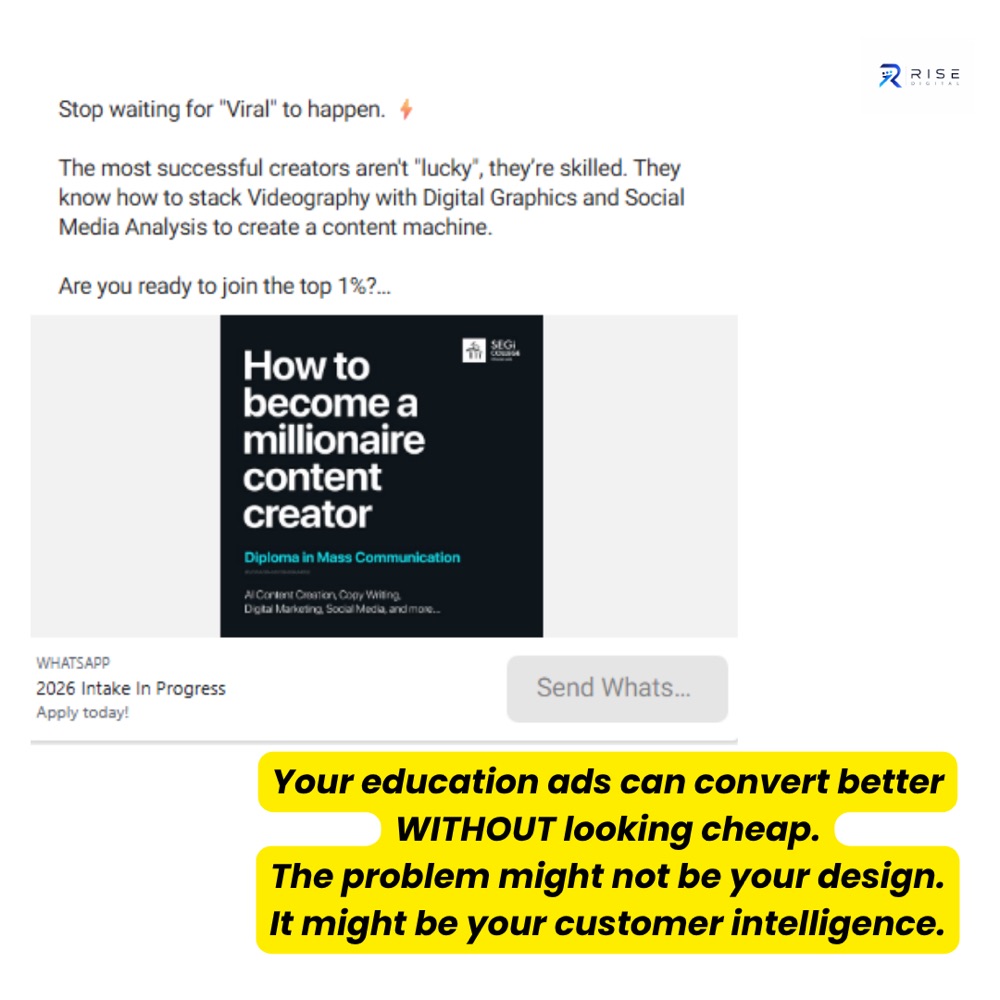
One of their ads stopped my scroll: "How to become a millionaire content creator."
That tells you two things straight away. First, SEGi is testing. They had around 37 ads live when I looked. Most Malaysian education brands run three. Testing at that volume is genuinely rare here and it is the hardest habit to build.
Second, an institution with SEGi's standing is not just advertising for enrolments. Every ad also has to protect and raise the perceived value of the brand. That is a much harder brief than "get leads", and it is where most education marketing quietly breaks.
So this is not a teardown. SEGi is doing the difficult part already. What follows is the layer I would add on top.
What is customer intelligence in marketing?
Customer intelligence is the practice of extracting the reasons real customers chose you, in their own language, from sources they wrote themselves. Reviews, testimonials, enrolment interviews, sales call notes, WhatsApp threads.
It is the step almost everyone skips. And it is the reason so much AI-assisted marketing sounds polished and converts poorly. AI is very good at producing confident marketing language. It cannot know why a working adult in Kota Damansara chose your diploma over the one down the road. If you do not feed it that, it guesses beautifully.
Our rule at Rise Digital: marketing-driven AI, not AI-driven marketing. Use AI to organise, extract and pattern-match real evidence. Never to invent the evidence.
The process I ran on SEGi, step by step
- Collect the raw voice. I pulled the public Google reviews for both SEGi University and SEGi College, separately, so the two audiences did not blur together.
- Compile, do not summarise yet. Copy the full review text into one document. Resist cleaning it up. The messy phrasing is the asset.
- Extract with a structured prompt. Feed it to ChatGPT, Claude, whichever you use, and ask specifically: what recurring reason do people give for choosing this institution, and what were they worried about before they enrolled? Not "summarise these reviews."
- Cluster into decision drivers. Group the output by what actually moved someone from considering to enrolling.
- Only then write the ad.
Steps one to four take about an hour. Almost nobody does them.
What SEGi's own reviewers revealed
Two dominant drivers came out of the review set:
- "I want to improve myself and my future through education." Self-betterment, framed around career progression rather than academic prestige.
- "I need an education pathway I can realistically access and complete." Accessibility. Affordability. The confidence that they will actually finish.
Underneath those, the recurring themes were career development, gratitude for scholarships and affordability, and being recommended by someone they trusted.
Which produces two clear personas, neither of them invented:
The ambitious practical learner. Wants hands-on, applied learning, not theory. Judges a course by whether it makes them employable.
The working adult upskilling. Already in a job. Limited time. Needs flexibility above almost everything else.
Their real objections before enrolling: limited academic results, no time because they are working, and the fear of wasting both money and years on something they will not complete.
That last one matters most. Their biggest fear is not cost. It is non-completion. Almost no education ad in Malaysia addresses it.
Why programme-focused ads underperform
Here is the diagnosis behind the question every education marketer asks me: why are our ads not converting?
Look at where your ads sit in the funnel. Most education advertising is bottom-of-funnel. Programme name, intake date, apply now, occasionally a discount. That copy assumes the reader has already chosen your institution and is picking a course.
But on Meta, ads now function largely as a discovery channel, not a decision channel. The person seeing your ad is usually finding out you exist and quietly comparing you against four other options they saw this week.
Bottom-of-funnel copy shown to a top-of-funnel audience produces exactly what you are seeing: clicks, traffic, cheap engagement, weak enrolments.
The missing layer is consideration. Ads that say here is what makes us different, here is how we compare, here is why students like you finish here. Make the comparison easy and you shorten the decision. Leave them to compare you on their own and you lose to whoever made it easier.
5 content angles built from the real student voice
Each one maps to a driver above, not to a brainstorm.
- "A better me." Self-improvement as the outcome, the qualification as the vehicle. Works because it is the number one reason their own students gave.
- "Study on my terms." Flexibility, part-time pathways, studying while working. Works because it removes the working adult's single biggest blocker.
- "Real-world ready." Labs, placements, industry projects, what graduates actually do on day one. Works because the practical learner buys employability, not curriculum.
- "Find my path." For the undecided school leaver who does not know what to study yet. Works because it meets a real state of confusion nobody else is speaking to.
- "Future security." The qualification as insurance against an unstable job market. Works because it reframes fees as risk reduction, not cost.
Find the format before you write the content
Angles tell you what to say. Formats tell you how it needs to look to survive the feed.
Before producing anything, search Instagram and Facebook for the terms your prospects use, "colleges in Malaysia", "diploma Malaysia", "part time degree", and sort by what is already getting engagement. Build a swipe file of the winning formats in your own category, and the strong ads running in education globally.
You are not copying. You are refusing to guess at format when the answer is publicly visible.
And use video. An image can carry one idea. A 20 second video can carry a student's face, their voice, their before and after, and your campus, all at once. For an audience whose core fear is "will I actually finish this", seeing someone who looks like them and did finish is the strongest asset you can run.
The one ad I would rewrite
"How to become a millionaire content creator" earns attention. I saw people discussing it, which is more than most education ads achieve. The risk is that it promises an outcome the institution cannot underwrite, and that creates doubt about everything else you claim.
Same hook, different promise:
Everyone wants to be a content creator. Almost nobody realises it is a marketing job. You need to understand funnels, paid and organic, copywriting, and customer psychology. Here is the full skill set, and here is where you learn it properly.
Now the ad is educational, the authority is yours, and the claim is one you can actually stand behind.
What I would test first at SEGi
If I could only change three things this month:
- Run one "study on my terms" flexibility ad against the current programme ad for the same course. Same budget, same audience. Let the data settle the argument.
- Add one consideration-stage asset, a straight comparison of what makes SEGi different, above the programme ads.
- Turn three existing Google reviews into three 20 second videos. No production budget required.
Frequently asked questions
How do I find out why students actually chose my institution?
Start with your public Google reviews, then your enrolment team's notes and any testimonial you have collected. Compile the raw text, run a structured extraction prompt over it, and cluster the results by decision driver. Reviews you already have are usually enough to begin.
Should education institutions use AI to write ads?
Yes, for organising research, extracting insight from real customer language, and producing variations to test. No, for inventing the insight itself. AI-generated copy built on guesswork sounds like marketing and performs like noise.
Why do my education ads get clicks but no enrolments?
Almost always a funnel mismatch. The ads are written for someone ready to apply, while the audience is still discovering and comparing. Add consideration-stage content that differentiates you and builds trust before the apply-now message.
How many ads should a college be running?
Enough to learn something. Testing a handful of angles, formats and headlines against each other beats perfecting one ad, and the volume only works if each variation comes from a different real insight rather than a reworded headline.
What is AEO and does it apply to education marketing?
Answer Engine Optimisation is making your institution the answer when someone asks an AI assistant a question like "best college in Malaysia for part-time business diploma". It runs on the same foundation as this article: clear, specific, evidence-backed answers in the language your actual students use.
Run this on your own institution
The framework is a repeatable sequence, customer intelligence, refined avatar, funnel-mapped angles, proven formats, structured testing. It exists so your marketing team never sits in front of a blank content calendar again, and never ships an ad built on a guess.
At Rise Digital we run this with in-house marketing teams, including a recent programme with an e-commerce enablement business training more than 20 performance and social marketers. It is also available as an HRDC-claimable workshop. We also trained more than 20+ businesses, leaders and marketers on adopting AEO and SEO via our HRDC claimable programmes.
If you are running education marketing in Malaysia and your ads are producing traffic instead of enrolments, this is almost certainly where the gap is.
Stephanie Lam is a fractional CMO and founder of Rise Digital, where she helps Malaysian businesses fix positioning before they scale spend.